

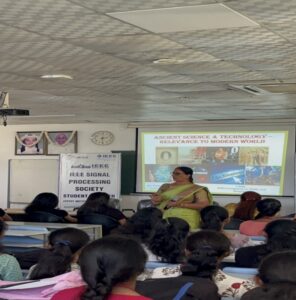
The IEEE Student Branch, JIT, in collaboration with the IEEE Signal Processing Society Student Chapter, organized an invited talk by Dr. Padmashree Anand on the topic “Indian Knowledge System – Ancient Science & Technology: Relevance to the Modern World” on 11th February 2026 from 2:00 PM to 3:30 PM in the ECE Seminar Hall, JIT Campus.
The event was conducted to create awareness about the Indian Knowledge System among the 6th Semester ECE students of Sections A and B. The program also aimed to promote awareness about IEEE and encourage students to actively participate in technical and professional development activities through IEEE initiatives.
The occasion was graced by the presence of the Chief Guest, Dr. Padmashree Anand, along with the Head of the ECE Department and Advisor of the IEEE SPS Student Chapter, Dr. Asha Bharathi S., and IEEE Student Branch Counselor Dr. Sowmya Padukone G.
The session provided valuable insights into the relevance of traditional Indian knowledge systems in the modern technological world and inspired students to engage in professional growth through IEEE platforms.
Student Deeksha S., of 6th Semester ECE, on behalf of the students, expressed heartfelt gratitude to the Management of Jyothy Institute of Technology for facilitating and supporting the successful conduct of the IEEE event. She also formally and cordially invited the dignitaries of the event. The session marked an enriching academic experience, highlighting the significance of Indian Knowledge Systems in contemporary education and research.
The event commenced with an invocation song rendered by Sanjana and Shriya of 6th Semester ECE. This was followed by an insightful talk on “Indian Knowledge System” delivered by the esteemed guest, Dr. Padmashree Anand.
The event concluded with a Vote of Thanks rendered by Kubra Shaik and Shwetha P. M., students of 6th Semester ECE.
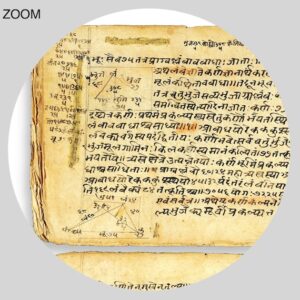
The Indian Knowledge System (IKS) represents the rich intellectual and scientific heritage developed in India over thousands of years. It encompasses diverse fields such as mathematics, astronomy, medicine, metallurgy, architecture, philosophy, governance, and environmental science.
Ancient Indian scholars combined observation, experimentation, logic, and spiritual insight to develop knowledge systems that continue to influence the modern world.
In the field of mathematics, scholars like Aryabhata and Brahmagupta made significant contributions, including the concept of zero, the decimal number system, algebraic methods, and astronomical calculations. These foundational ideas form the backbone of modern mathematics, computing, and digital technologies.
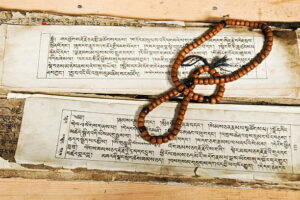
This image appears to be a page from an ancient Indian Sanskrit manuscript, likely related to mathematics or astronomy. The text is written in Devanagari script on what looks like palm leaf or early handmade paper, indicating a traditional scholarly document. The main body contains neatly written Sanskrit shlokas (verses). Ancient Indian scientific knowledge was often written in verse form to make it easier to memorize and transmit orally.
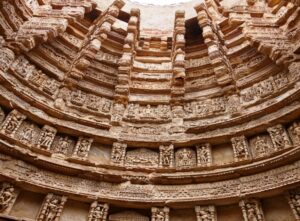
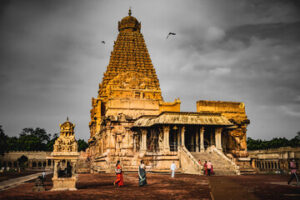
Ancient Indian architecture and structural engineering demonstrate advanced scientific knowledge, precision, and sustainability. Traditional Indian builders combined mathematics, geometry, material science, and environmental understanding to construct durable and aesthetically remarkable structures that have survived for centuries.
One of the foundational texts in this field is Vastu Shastra, which outlines principles of planning, orientation, ventilation, structural layout, and energy flow in buildings. These principles emphasize harmony with nature, optimal sunlight, airflow, and structural balance—concepts that align closely with modern sustainable architecture and green building design.
This image shows the intricate inner stone carvings of the Konark Sun Temple. It is a 13th-century temple located in Odisha, India, dedicated to the Sun God Surya. The temple is famous for:
The curved, concentric structure visible in the image is part of the temple’s ornate architectural detailing, showcasing the mastery of ancient Indian stone craftsmanship and structural design. It is considered one of the finest examples of ancient Indian temple architecture and is a UNESCO World Heritage Site.
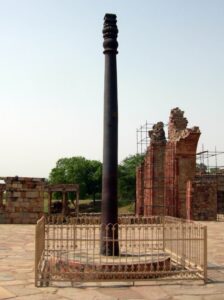
Ancient India made remarkable contributions to metallurgy and materials science, demonstrating advanced knowledge of metal extraction, alloy formation, corrosion resistance, and material processing techniques.
One of the most famous examples is the Iron Pillar of Delhi, which has stood for more than 1,600 years without significant rusting. This pillar reflects advanced understanding of iron purification and corrosion-resistant properties. Modern studies show that its high phosphorus content and protective oxide layer contribute to its durability, showcasing early expertise in material engineering.
Ancient Indian metallurgy principles are relevant today in:
Today, innovation depends on interdisciplinary collaboration—combining engineering, artificial intelligence, environmental science, healthcare, and social sciences. The Indian Knowledge System provides a model of integrated thinking where:
This holistic and interconnected approach is highly relevant in solving modern global challenges such as climate change, healthcare innovation, smart infrastructure, and sustainable development.
Indian scientific traditions demonstrate that interdisciplinary thinking is not new but deeply rooted in ancient knowledge systems. By integrating science, technology, philosophy, and social responsibility, the Indian Knowledge System offers valuable insights for modern research, innovation, and sustainable progress.
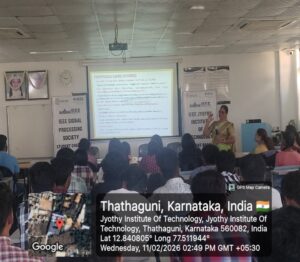
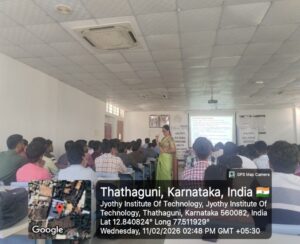
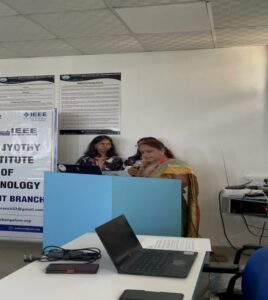
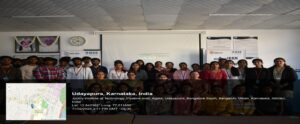
There were 11 IEEE members and 83 Non-IEEE members present for the invited talk.
The Department of Electronics and Communication Engineering (ECE) expresses its sincere gratitude to Dr. Padmashree Anand for gracing the event and delivering an inspiring and insightful talk.
We extend our special thanks to Dr. Asha Bharathi S., Advisor, IEEE SPS Chapter, and Mrs. Krithika P. J., Event Coordinator, for their valuable guidance and support.
We also convey our heartfelt appreciation to all the faculty members of the ECE Department and the 6th Semester ECE students whose dedicated efforts contributed significantly to the grand success of the event.