

| Particulars | Details |
|---|---|
| Topic | Quantum Computing and its Applications |
| Resource Person | Shri H. D. Ananda |
| Designation | Former Scientist & Systems Leader, Master Control Facility (MCF), ISRO, Hassan |
| Date | 11 March 2026 |
| Time | 2:00 PM – 4:00 PM |
| Venue | Auditorium, Jyothy Institute of Technology |
| Participants | Staff Members and 4th Semester Students (ISE & AIML) |
| Duration | 2 Hours |
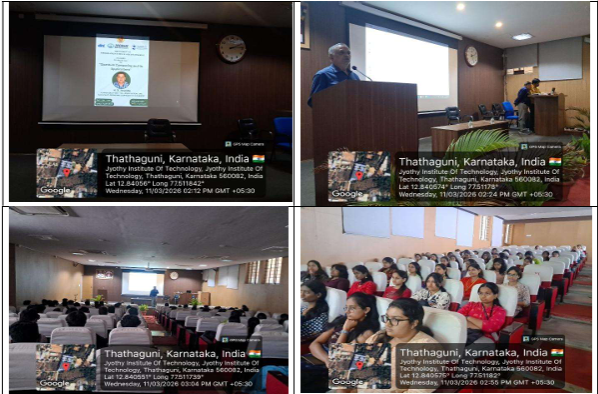
The Department of Information Science and Engineering organized a technical talk on “Quantum Computing and its Applications” on 11 March 2026 at the JIT Auditorium. The session was delivered by Shri H. D. Ananda, a distinguished former Scientist and Systems Leader from the Master Control Facility (MCF), ISRO, Hassan.
The lecture aimed to introduce students and faculty members to the fundamentals of quantum computing, its underlying scientific principles, and its transformative applications in computing, cybersecurity, and space technology. The session attracted enthusiastic participation from students of the ISE and AIML departments, along with faculty members from various disciplines.
Shri H. D. Ananda has over 38 years of distinguished service at the Indian Space Research Organisation (ISRO). He holds an M.Sc. in Physics and a Post Graduate Diploma in Computer Programming from the University of Mysore.
Throughout his career, he made significant contributions to spacecraft operations, mission control software development, satellite mission support, orbit-raising operations, and ground system automation. He played an instrumental role in managing more than 50 satellite missions and contributed extensively to the development of mission-critical software systems.
He also represented ISRO internationally during the INSAT-2D mission in Italy and led several initiatives involving software quality standards and optical monitoring systems for Indian space assets. Following his retirement in January 2024 as Group Director, SPROC Systems, he continues to promote space science education through guest lectures and student mentoring.
The session covered the following major topics:
| Category | Topics Discussed |
|---|---|
| Quantum Computing Fundamentals | Classical Computing vs. Quantum Computing, Bits and Qubits |
| Quantum Principles | Superposition, Entanglement, Quantum Parallelism |
| Quantum Technologies | Quantum Cryptography, Quantum Key Distribution (QKD) |
| Applications | Secure Communication, Cybersecurity, Optimization, Material Science, Space Systems |
| Emerging Technologies | Quantum Sensors, Quantum Clocks, Satellite-based Quantum Communication |
| Career Guidance | Interdisciplinary Learning, Research Opportunities in Quantum Computing and Space Technology |
During the lecture, Shri H. D. Ananda explained the fundamental differences between classical and quantum computing. He illustrated how classical computers process information using binary bits, whereas quantum computers utilize qubits capable of existing in multiple states simultaneously through the principles of superposition and entanglement.
The speaker demonstrated how these quantum properties enable computers to solve highly complex computational problems much faster than conventional systems. He also discussed the growing significance of quantum computing in solving optimization problems, scientific simulations, cryptography, and artificial intelligence.
A major focus of the session was the application of Quantum Key Distribution (QKD) and quantum cryptography for developing highly secure communication systems capable of protecting sensitive information from cyber threats.
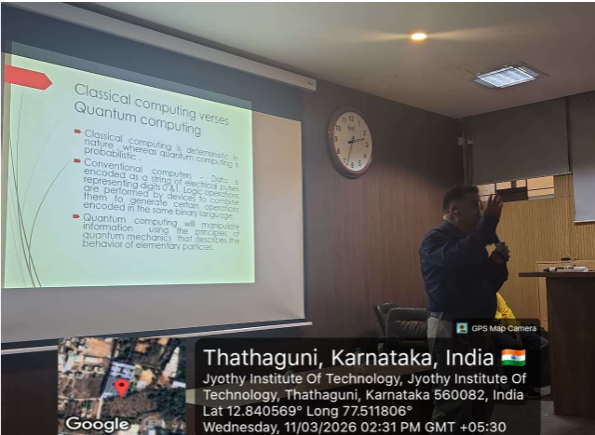
One of the most insightful segments of the lecture focused on the role of quantum technologies in modern space missions.
Shri Ananda explained how leading space agencies are developing satellite-based quantum communication systems capable of securely transmitting encryption keys over long distances. These technologies have the potential to revolutionize secure communications for defense organizations, government agencies, financial institutions, and satellite networks.
The speaker also discussed the importance of quantum sensors and quantum clocks in improving satellite navigation, gravitational measurements, precision timing, and deep-space exploration. He emphasized that quantum technologies will become an integral component of future space missions and next-generation communication infrastructure.
At the end of the session, participants were able to:
The session concluded with an engaging interactive discussion where students raised questions related to quantum computing, research opportunities, and careers in space technology. Shri Ananda encouraged students to strengthen their fundamentals in Physics, Mathematics, and Computer Science and motivated them to pursue interdisciplinary learning to excel in emerging technologies.
The technical talk on “Quantum Computing and its Applications” was highly informative and inspiring. Shri H. D. Ananda effectively combined his vast experience in spacecraft operations with practical insights into the future of quantum technologies. The session provided participants with a comprehensive understanding of quantum computing, secure communication, and advanced space applications while highlighting the growing significance of interdisciplinary research.
The lecture successfully motivated students to explore emerging domains such as quantum computing, cybersecurity, and space science, making it a valuable addition to their academic and professional development.
