




| Particulars | Details |
|---|---|
| Topic | Algorithms in Action: Foundations and Real-World Applications |
| Resource Person | Dr. Ananda Babu J |
| Designation | Professor & Head, Department of Information Science & Engineering |
| Institution | Malnad College of Engineering (MCE), Hassan |
| Date | 13 May 2026 |
| Time | 11:30 AM – 12:30 PM |
| Venue | EC Seminar Hall, Jyothy Institute of Technology, Bangalore |
| Duration | 1 Hour |
The Department of Information Science and Engineering organized an expert lecture on “Algorithms in Action: Foundations and Real-World Applications” to strengthen students’ understanding of fundamental algorithms and their practical significance. The session was delivered by Dr. Ananda Babu J, Professor and Head, Department of Information Science and Engineering, Malnad College of Engineering, Hassan.
The lecture focused on connecting theoretical concepts with practical problem-solving techniques by illustrating how algorithms are used in real-world applications such as navigation systems, search engines, social networks, and data processing. Through interactive demonstrations and engaging discussions, students gained a deeper appreciation of algorithm design, computational efficiency, and analytical thinking.
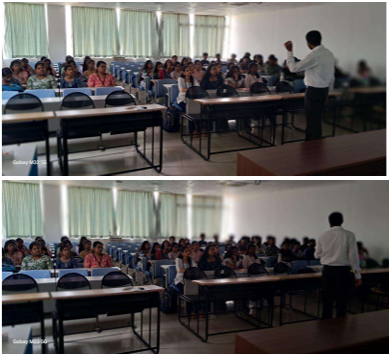
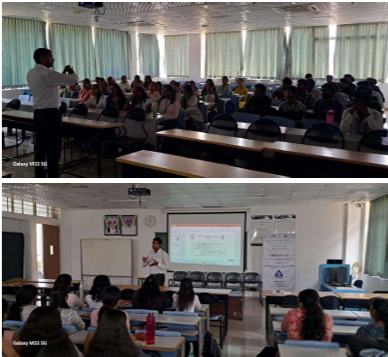
The session introduced students to the following core algorithmic concepts.
| Category | Algorithms Covered |
|---|---|
| Search Algorithms | Binary Search, Breadth First Search (BFS), Depth First Search (DFS) |
| Sorting Algorithms | Insertion Sort, Merge Sort, Quick Sort |
| Tree Algorithms | Binary Tree Traversals (Inorder, Preorder, Postorder) |
| Algorithm Analysis | Best Case, Average Case, Worst Case, Time Complexity |
| Algorithm | Best Case | Average Case | Worst Case |
|---|---|---|---|
| Binary Search | O(1) | O(log n) | O(log n) |
| Breadth First Search (BFS) | O(V + E) | O(V + E) | O(V + E) |
| Depth First Search (DFS) | O(V + E) | O(V + E) | O(V + E) |
| Insertion Sort | O(n) | O(n²) | O(n²) |
| Merge Sort | O(n log n) | O(n log n) | O(n log n) |
| Quick Sort | O(n log n) | O(n log n) | O(n²) |
| Tree Traversals | O(n) | O(n) | O(n) |
The speaker explained how choosing the appropriate algorithm significantly improves efficiency depending on the problem.
| Problem Scenario | Recommended Algorithm |
|---|---|
| Searching in sorted data | Binary Search |
| Sorting a small dataset | Insertion Sort |
| Sorting large datasets | Merge Sort |
| Fast general-purpose sorting | Quick Sort |
| Shortest path / Level-wise traversal | Breadth First Search (BFS) |
| Deep exploration / Backtracking | Depth First Search (DFS) |
| Processing hierarchical data | Tree Traversals |
To simplify complex concepts, the speaker conducted several classroom activities that allowed students to experience algorithm execution practically.
| Algorithm | Activity | Learning Outcome |
|---|---|---|
| Binary Search | Guess the Number | Understood divide-and-conquer search strategy |
| Depth First Search | Classroom Maze Exploration | Learned recursive exploration and backtracking |
| Breadth First Search | Friend Circle Expansion | Visualized level-order traversal and shortest path |
| Insertion Sort | Arrange Number Cards | Understood incremental sorting and element shifting |
| Merge Sort | Group Sorting Challenge | Learned divide-and-conquer and merging techniques |
| Quick Sort | Pivot Student Activity | Understood partitioning and recursive sorting |
| Tree Traversals | Human Binary Tree | Visualized inorder, preorder, and postorder traversals |
The lecture enabled students to understand that algorithms are practical tools used in solving real-world computational problems rather than abstract theoretical concepts. The speaker emphasized the importance of selecting suitable algorithms to optimize performance and resource utilization.
Students also learned that:
At the end of the session, participants were able to:
The guest lecture by Dr. Ananda Babu J was highly informative and engaging. By combining theoretical knowledge with practical demonstrations and interactive classroom activities, the session made complex algorithmic concepts easy to understand and enjoyable to learn. Students developed a stronger foundation in algorithm design, complexity analysis, and problem-solving techniques while gaining valuable insights into the real-world applications of computer science. The lecture significantly enhanced students’ readiness for advanced algorithm courses, competitive programming, software development, and technical interviews.
