



Date: 15/04/2026
Time: 11:30AM – 12:30 PM
Venue: Auditorium, JIT
Audience: Staff and Students(4th Sem ISE)
1. Workshop Overview
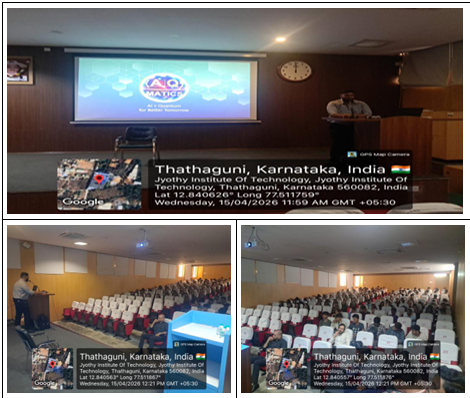
The Quantum Computing Foundational Session is a 60-minute introductory programme organized by AQMATICS and conducted at Jyothy Institute of Technology (JIT). The session was designed to familiarize students with the core principles of quantum mechanics as applied to computation, offering a conceptual bridge between classical computing paradigms and the emerging quantum frontier. The workshop aimed to create awareness of the paradigm shift from classical bits to qubits and illuminate the potential of quantum-classical hybrid systems in tackling NP-hard (Nondeterministic Polynomial time) problems. By the end of the session, participants gained a foundational conceptual understanding of quantum gates, qubit behaviour, and the current state of the global quantum computing ecosystem.
2. Target Audience
The workshop was open to all interested students, with a primary focus on the following groups:
Career Interest Areas The workshop is particularly relevant to students exploring career pathways in:
3. Delivery Model
The workshop was conducted in offline (in-person) mode at the Jyothy Institute of Technology campus. The complete session was delivered by an AQMATICS-certified trainer, who provided an engaging introduction to the fundamentals of quantum computing. The programme commenced with a 15-minute inaugural session attended by the Principal and Heads of Departments, followed by the technical session.
The workshop introduced participants to the fundamental concepts of quantum computing through the following topics:
The 60-minute workshop was divided into four interactive modules, each designed to progressively enhance students’ understanding of quantum computing concepts.
Students from various engineering disciplines actively participated in the workshop. Registration was managed through an official Google Form created by Jyothy Institute of Technology, ensuring efficient attendance management and timely communication with participants. Registration details included the student’s name, institutional email address, department, year of study, and contact number. The collected information was used solely for event coordination, attendance verification, and post-workshop communication in accordance with institutional data privacy guidelines.
The workshop was conducted in the JIT Auditorium, which was equipped with all the necessary facilities to ensure the smooth delivery of the programme. The venue included a projector and projection screen, HDMI connectivity, a microphone and speaker system, high-speed internet access, and adequate seating arrangements for all participants. Dedicated IT support was also provided throughout the session.
The successful execution of the workshop was a collaborative effort between AQMATICS and Jyothy Institute of Technology.
AQMATICS was responsible for providing a certified trainer, delivering the technical session, and supplying the presentation materials and learning resources.
Jyothy Institute of Technology facilitated the event by providing the venue and technical infrastructure, coordinating student registrations, promoting the workshop across departments, offering IT support during the session, and managing the overall scheduling and logistics.
The Quantum Computing Foundational Session, organized by AQMATICS and hosted at Jyothy Institute of Technology on 15 April 2026, successfully introduced students to the rapidly evolving field of quantum computing. The workshop covered essential concepts such as qubits, superposition, entanglement, quantum circuits, and Post-Quantum Cryptography while also highlighting emerging career opportunities in the quantum ecosystem. The interactive offline format encouraged active participation and meaningful discussions, inspiring students to explore advanced studies and careers in quantum technologies. The programme served as an important step toward preparing students for the future of computing, cybersecurity, and scientific innovation.